
English ![]()

T: +86-15903202172
E: sales@xs-foundry.com
E: sales@xs-foundry.com
Linzhang Jian'an West Road 569, Handan City, Hebei Province

Have you ever walked down a city street, heard the distinct clank of a car tire hitting a metal lid, and wondered, “Just how heavy is a manhole cover?”It’s a question that crosses the minds of curious pedestrians, but it’s a critical calculation for construction managers, civil engineers, and urban planners. A cover that is too light might flip over under the weight of a passing truck, causing catastrophic accidents. A cover that is unnecessarily heavy complicates maintenance and increases injury risks for utility workers.
The quick answer is that a standard cast iron manhole cover typically weighs between 200 and 300 pounds (90 to 136 kg). However, this number is far from a universal constant.
In reality, weight is not a single number but a spectrum. A small composite cover for a residential garden might weigh as little as 20 pounds, while a massive airport-rated cover can tip the scales at over 500 pounds. The final weight depends entirely on the material used, the size of the opening, the load rating required, and the specific application.
In this guide, we will break down exactly how weight is determined, why it matters for safety, and how to choose the right specification for your project.
Because manhole covers are used in everything from quiet sidewalks to busy highways, their weights vary drastically. To get a clear picture, we need to look at the ranges based on their intended use.
Broadly speaking, manhole covers fall into a weight range of 90 lbs to 500+ lbs (40 kg to 225+ kg) for standard iron products.
If you include modern composite materials used for lighter applications, the floor drops significantly, starting around 20 lbs (9 kg). On the other end of the spectrum, specialized, reinforced airport covers can easily exceed 800 lbs (360 kg).
When most people ask this question, they are picturing the round, cast iron disc found in the middle of a city street. This is often referred to as a “municipal” or “standard traffic” cover.
For these common road applications, the sweet spot is usually 250 to 300 lbs (113 to 136 kg).
Why this specific weight? It is heavy enough to remain stable when a 40-ton truck drives over it at 40 mph, yet it is still manageable for a maintenance crew to lift using standard removal hooks or magnetic lifters.
You might wonder why manufacturers don’t just agree on a single 250 lb standard. The reason lies in the diversity of infrastructure.
A telecommunications vault in a grassy park doesn’t need the same protection as a sewer access point in the middle of a freeway. Manufacturing a heavy-duty cover for a low-traffic area is a waste of money and resources. Conversely, installing a light-duty cover on a highway is a recipe for disaster. Therefore, weight fluctuates based on the “load rating”—the amount of weight the cover is certified to hold.
To help you visualize the differences, here is a quick breakdown:
Lightweight (20–100 lbs): Used for pedestrian areas, gardens, and residential driveways. Often made of composite materials or thin steel.
Medium/Standard (150–300 lbs): The workhorse of urban infrastructure. Used on city streets, parking lots, and alleyways. Usually made of grey cast iron or ductile iron.
Heavy-Duty (350–500+ lbs): Found in industrial zones, airports, and shipping docks where extreme loads (like forklifts or airplanes) are present.
The single biggest factor influencing weight is the material composition. While iron is traditional, modern engineering has introduced lighter, stronger alternatives.
| Material Type | Typical Weight | Strength & Load Performance |
|---|---|---|
| Cast Iron (Grey Iron) | 250–400 lbs (113–180 kg) | High load capacity, brittle, relies on thickness |
| Ductile Iron | 150–250 lbs (68–113 kg) | High strength-to-weight, impact-resistant |
| Composite (FRP / Resin) | 30–90 lbs (13–40 kg) | Engineered for heavy loads (up to D400) |
| Concrete | 400+ lbs (180+ kg) | Extremely strong, very inflexible |
| Steel (Pressed / Galvanized) | 50–100 lbs (23–45 kg) | Low–moderate load, light-duty use |
Grey cast iron is the traditional material for manhole covers. It is dense, rigid, and incredibly heavy. Because grey iron is brittle, the covers must be made thicker to provide the necessary strength to support vehicles.
Typical Weight: 250–400 lbs (113–180 kg)
Pros: Inexpensive to manufacture, stays in place due to sheer mass.
Cons: Extremely heavy to move; prone to cracking if dropped.
Ductile iron is a modern evolution of cast iron. By adding magnesium to the molten iron, the metal becomes more flexible and stronger on a molecular level. Because ductile iron has a higher strength-to-weight ratio, manufacturers can make the covers thinner without sacrificing safety.
Typical Weight: 150–250 lbs (68–113 kg)
Pros: Lighter than grey iron but just as strong; resists cracking.
Cons: Slightly more expensive than standard grey iron.
Composite covers—typically made from fiberglass-reinforced plastic (FRP) or resin—are changing the industry. They are designed to be strong but significantly lighter than metal.
Typical Weight: 30–90 lbs (13–40 kg)
Pros: Can be lifted by a single person; zero scrap value (prevents theft); corrosion-resistant.
Cons: Can be more expensive upfront; requires specific locking mechanisms to stay secure since they lack the mass to hold themselves down.
One common misconception is that “lightweight” means “weak.” High-quality composite covers can be rated for heavy roadway traffic (D400 class) while weighing a fraction of their iron counterparts.
You may occasionally see covers made of concrete encased in a steel rim, or simple galvanized steel plates.
Concrete: These are exceptionally heavy, often exceeding 400 lbs. They are typically used for large utility vaults where access is rarely required.
Steel: Pressed steel covers are generally light (50–100 lbs) but are not suitable for high-speed traffic. They are mostly found on sidewalks or private driveways.
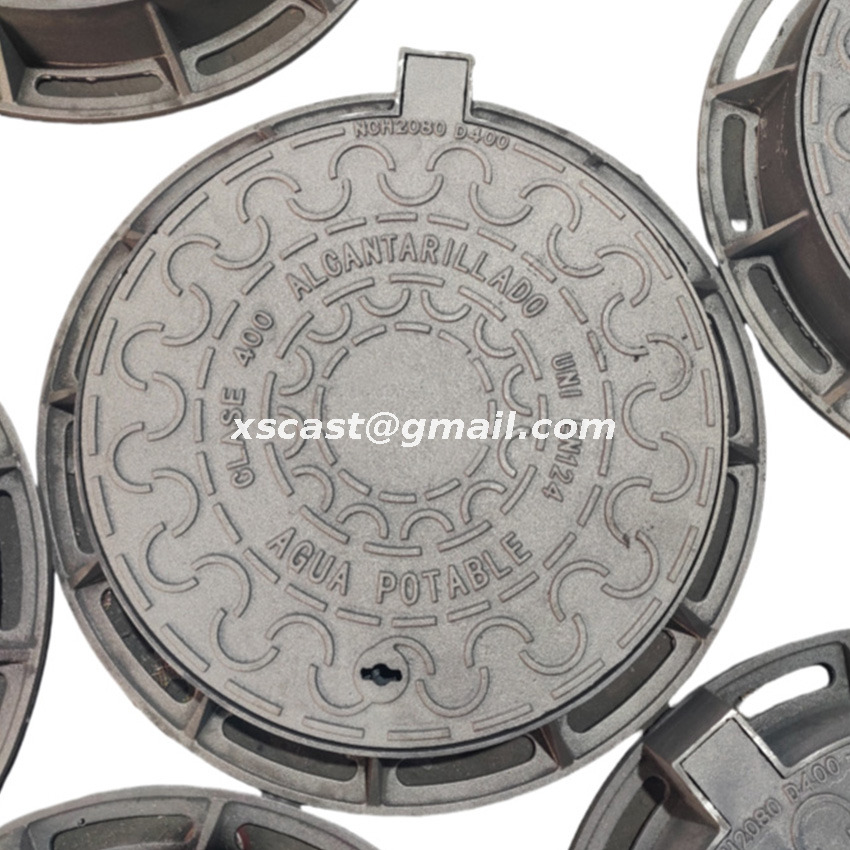
Learn more About XSCAST Manhole cover
It’s simple physics: the larger the hole you need to cover, the more material is required, and the heavier the cover becomes.
These smaller covers are often used for inspecting valves, water meters, or smaller cable junctions.
Weight Range: 90–150 lbs (Iron) / 25–40 lbs (Composite)
Common Use: Sidewalks, residential streets, and small utility access points.
The 24-inch (600mm) clear opening is the industry standard for man entry. If a person needs to fit through the hole to clean a sewer, this is the minimum size.
Weight Range: 175–275 lbs (Iron) / 50–100 lbs (Composite)
Common Use: City streets, sanitary sewers, and storm drains.
Once you move past 36 inches, weight increases exponentially. These covers are massive to ensure they don’t flex or collapse over the wider span.
Weight Range: 300–600+ lbs
Common Use: Large utility vaults, transformer access, and major junction points.
Handling Note: These covers almost always require mechanical assistance (like a hydraulic arm or vehicle-mounted hoist) to remove safely.
You cannot determine a cover’s weight just by looking at its size. A 24-inch cover designed for a sidewalk will be much lighter than a 24-inch cover designed for an airport runway. This is determined by load ratings.
The “load rating” is the maximum amount of weight a cover can bear without failing. To achieve a higher load rating, manufacturers must either use stronger materials or add more material (thickness), which increases the weight.
In Europe and many international markets, the BS EN 124 standard dictates these ratings. In the US, AASHTO standards are often used, but the principles are similar.
A15 (Pedestrian - 1.5 tonnes): Very light. Often 20–50 lbs.
B125 (Car Parks - 12.5 tonnes): Medium weight. Often 90–150 lbs.
C250 (Roadside - 25 tonnes): Heavy. Often 150–200 lbs.
D400 (Main Roads - 40 tonnes): Very heavy. 200–350 lbs.
E600/F900 (Airports/Docks): Extremely heavy. 400–800+ lbs.
It isn’t just about the weight of the car sitting on the cover (static load). It is about the dynamic load.
When a truck slams on its brakes over a manhole cover, or hits it at 60 mph, the forces exerted are tremendous. A lightweight cover might survive the weight of the truck but could shatter under the impact or vibration. Heavier covers have the mass and structural integrity to absorb these dynamic shocks without failing.
If we have strong, lightweight materials like carbon fiber, why do cities still prefer 300-pound slabs of iron? The weight itself is actually a feature, not a bug.
This is the most critical factor. If a cover is too light, the “suction” effect created by a fast-moving truck passing over it can literally lift the cover out of its frame. This is known as the “pop-top” effect.
A dislodged manhole cover is deadly. It leaves an open pit in the road for the next car to fall into, and the flying metal disc becomes a projectile. The heavy weight of cast iron uses gravity to ensure the cover stays seated firmly in its frame, regardless of traffic speed.
Underground tunnels are dangerous places filled with toxic gases, high-voltage cables, and sewage. Cities do not want curious teenagers, urban explorers, or copper thieves entering these spaces.
A cover that weighs 250 pounds acts as a passive security lock. It cannot be lifted by hand without tools and effort. This naturally deters unauthorized entry.
Heavy covers settle into their frames securely. Lighter covers, if not fastened down with bolts, tend to rattle.
Imagine trying to sleep in an apartment where every car that drives by causes a metal CLANG-CLANG outside your window. The mass of iron dampens vibration and noise. Additionally, heavy covers are less likely to be shifted by severe flooding, whereas lighter composite covers often need rubber gaskets and locking bolts to prevent them from floating away during storm surges.
When procurement managers order a “manhole cover,” they are usually ordering a “cover and frame set.” You cannot install a cover without the rim it sits in.
It is important to distinguish between the lid weight (what the worker lifts) and the total unit weight (what the shipping department handles).
The frame usually adds about 30% to 50% more weight to the total assembly.
If a standard D400 ductile iron cover weighs 180 lbs, the frame might weigh another 80 to 100 lbs.
Standard Road Frame: Adds ~70–120 lbs.
Heavy Duty Frame: Adds ~150+ lbs.
This distinction is vital for logistics. If an engineer estimates shipping costs based on the 200 lb cover weight, but forgets the 100 lb frame, the shipment will be overweight, and the installation crew might not have the right equipment to offload it.
Frames are also often bedded into concrete. A heavier, wider frame distributes the traffic load better into the surrounding road surface, preventing the asphalt from cracking around the manhole.
Selecting a manhole cover isn’t about guessing; it’s about matching the specs to the environment.
Sidewalks: Stick to lighter B125 covers. There is no need to pay for 300 lbs of iron when 100 lbs will do.
City Streets: D400 ductile iron is the industry standard. Do not cut corners here—using a C250 cover in a D400 zone is a liability risk.
Backyards/Patios: Composite A15 covers are perfect. They are aesthetically pleasing, won’t rust, and are safe for lawnmowers.
If a manhole needs to be accessed weekly (for example, a grease trap at a restaurant), a 300 lb iron cover is a worker’s compensation claim waiting to happen. In high-frequency access areas, opt for:
Composite covers (lightweight).
Spring-assisted hinged covers (iron covers that use mechanical struts to make lifting easy).
The industry is slowly shifting toward lighter options where safety permits. Composite covers are booming in telecommunications. Since telecom workers need to access fiber optic cables frequently, and these cables run under sidewalks rather than centers of roads, the heavy iron covers are being phased out in favor of lighter, lockable composite units that prevent back injuries.
Handan Xiangsheng Cast Co., Ltd. manufactures cast iron and ductile iron manhole covers for municipal and industrial applications, with full control over material quality, load rating, and dimensional accuracy.
Founded in 1999, the company operates a 46,000㎡ foundry with 30,000 tons annual capacity, offering EN 124–compliant solutions backed by in-house testing and machining.
Contact us to discuss specifications or project requirements!
