
English ![]()

T: +86-15903202172
E: sales@xs-foundry.com
E: sales@xs-foundry.com
Linzhang Jian'an West Road 569, Handan City, Hebei Province
Views: 0 Author: Site Editor Publish Time: 2026-01-21 Origin: Site
By 2026, the humble manhole cover has evolved from a simple slab of iron into a sophisticated infrastructure component, born from a manufacturing process that balances centuries-old casting traditions with cutting-edge technology.
For civil engineers, municipal planners, and construction professionals, understanding how these essential access points are produced is no longer just about curiosity—it’s about compliance, safety, and sustainability. The manufacturing landscape has shifted significantly, driven by stricter environmental regulations, the demand for higher load ratings, and the need for smarter, longer-lasting city infrastructure.
This guide takes you inside the heavy-duty foundry of 2026 to reveal exactly how manhole covers are made today.
The core concept of casting—pouring molten metal into a mold—remains unchanged, but everything surrounding it has been revolutionized. In 2026, the manufacturing of manhole covers is defined by four key forces: standards, safety, sustainability, and automation.
Historically, manhole cover production was often inconsistent, with variations in weight and material quality leading to premature failures. Today, the process is tightly regulated. Foundries are no longer just metal shops; they are data-driven manufacturing hubs where every batch of iron is tracked, analyzed, and certified before it ever reaches a mold.
The shift has been driven largely by the need for consistency. With heavier traffic loads on modern roads and a global push for “Vision Zero” safety standards, a cracked or loose manhole cover is a liability no city can afford. Consequently, the “how” of manufacturing is now inextricably linked to the “why”—producing covers that don’t just fit a hole but actively contribute to the safety and durability of the road network.
Furthermore, environmental pressures have reshaped the industry. In 2026, a foundry is judged not just by its output but by its carbon footprint. From closed-loop sand recycling systems to electric induction furnaces powered by renewable energy, the journey of a manhole cover is now greener than ever before.
Before a single spark flies in the foundry, the destiny of a manhole cover is determined by strict engineering criteria. It is not a one-size-fits-all process; the intended use dictates the manufacturing path.
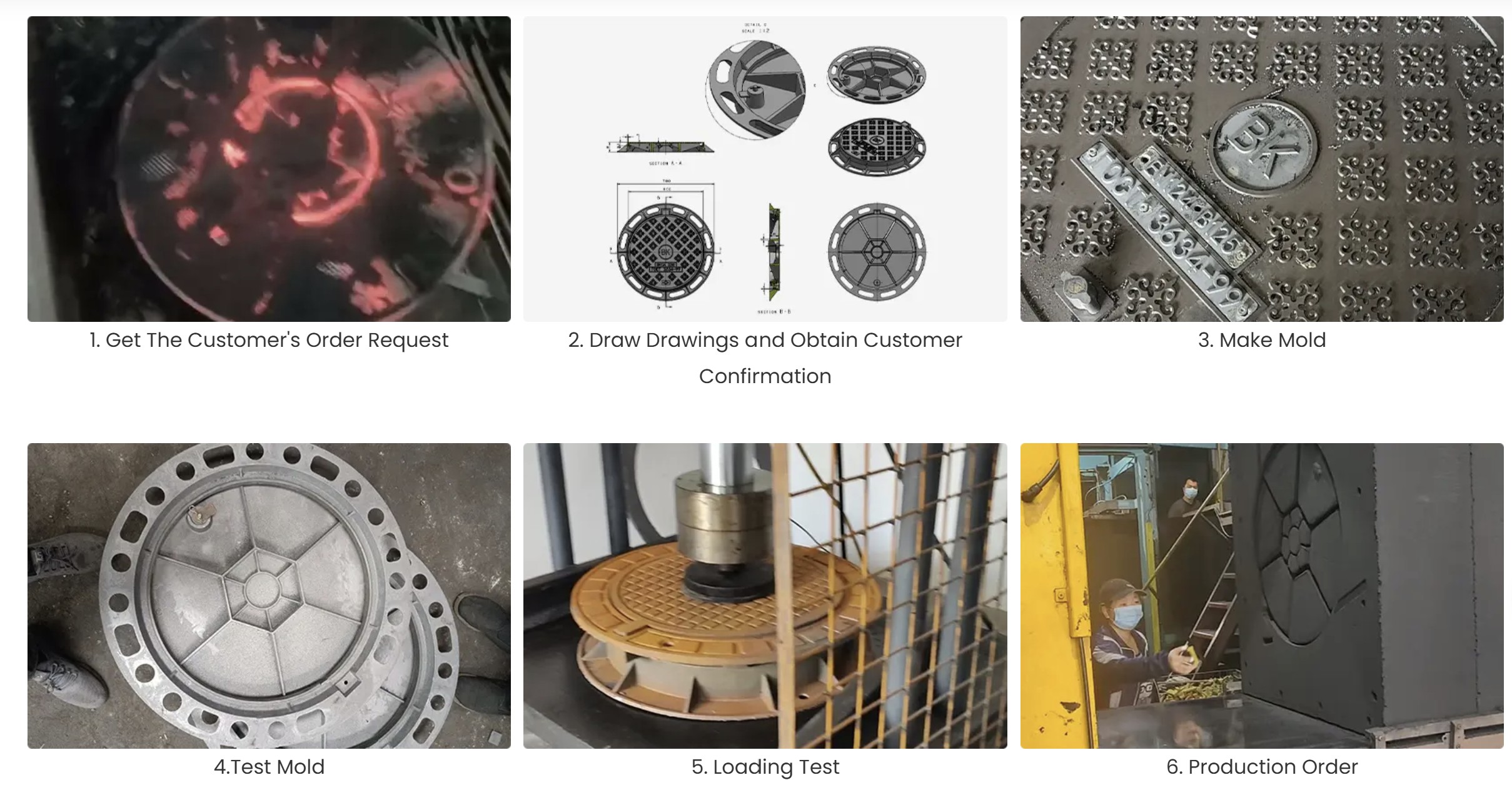
Learn More About How xs-foundry manufacture ManHole Cover
In 2026, manufacturing starts with the rulebook. Standards such as EN 124 (Europe) and AASHTO (USA) act as the blueprint for production. These regulations define traffic classes, ranging from pedestrian-only zones (Class A) to high-load airport runways (Class F).
These ratings dictate the physical geometry of the cover. A cover designed for a quiet residential street requires less material and a different rib structure than one destined for a busy freight terminal. Manufacturers use these load requirements to calculate the precise thickness and depth of the cover, ensuring it can withstand dynamic traffic loads without warping or fracturing.
The choice of material is the single biggest factor in the manufacturing process. While grey iron was once the standard, 2026 sees a clear segmentation in material use:
Ductile Iron (Spheroidal Graphite Iron): This is the dominant material for heavy-duty applications. Its superior strength-to-weight ratio allows for lighter, easier-to-handle covers that can still support immense loads.
Grey Iron (Cast Iron): Still used, but primarily for lighter, non-traffic applications or historic preservation projects where bulk and rigidity are preferred over tensile strength.
Composite Materials: Rising in popularity for specific niche applications like telecommunications or areas prone to theft, as they have no scrap value.
Modern manufacturing is also driven by the concept of “lifecycle cost.” Municipalities in 2026 are looking 20 or 30 years down the road. They want covers that won’t polish to a slippery shine after five years or rattle in their frames after ten.
This demand influences manufacturing choices, such as the inclusion of specific anti-slip patterns cast directly into the surface and the machining of bearing surfaces to ensure a silent, non-rocking fit. The goal is a “fit-and-forget” product that minimizes maintenance crews’ exposure to traffic and reduces long-term replacement costs.
The journey from raw scrap to a finished road-ready product is a sequence of precise, controlled steps. Here is how the standard heavy-duty manhole cover is produced in 2026.
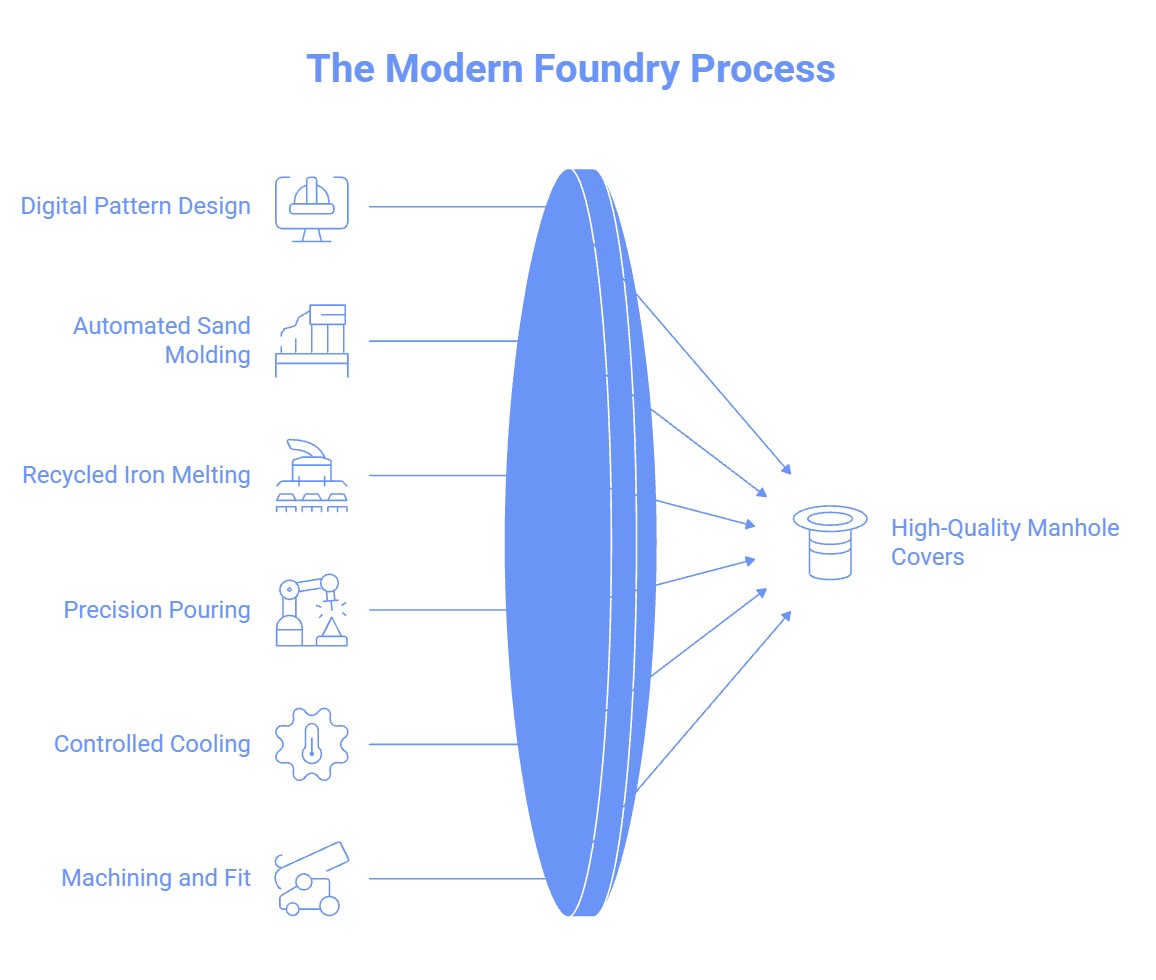
The days of hand-carving wooden patterns are largely over. In 2026, the process begins in a digital environment. Engineers use CAD (Computer-Aided Design) software to create 3D models of the cover and frame.
This digital approach allows for “finite element analysis”—simulating stress loads on the computer before a prototype is even cast. It also allows engineers to calculate “shrinkage allowance” with extreme precision. Molten iron shrinks as it cools; digital modeling ensures the pattern is sized exactly right so the final, cooled product meets strict dimensional tolerances.
Once the design is finalized, physical patterns are machined, usually from aluminum or high-density resin. These patterns are then used to create the sand molds.
While chemical resin sands are available, green sand (a mixture of silica sand, clay, water, and carbonaceous additives) remains the industry standard for high-volume production due to its reusability and cost-effectiveness.
In modern foundries, this step is heavily automated. High-pressure molding machines press the sand around the pattern plates within metal frames called “flasks.” This automation ensures consistent mold density, which is critical for maintaining surface finish and dimensional accuracy. A loose mold leads to a rough, misshapen cover; a machine-packed mold ensures a crisp, clean casting every time.
The “heart” of the foundry is the furnace. In 2026, sustainability mandates mean that nearly all manhole covers are made from recycled scrap iron—old car engines, steel beams, and manufacturing offcuts.
This scrap is melted in electric induction furnaces at temperatures exceeding 1500°C (2700°F). But melting is just the beginning. The metallurgy must be precisely adjusted. Spectrometers analyze the molten bath in real-time, allowing metallurgists to tweak the chemistry. They add carbon for fluidity, silicon for graphitization, and—crucially for ductile iron—magnesium to change the graphite structure from flakes to nodules.
Pouring molten iron is an art form engineered for safety and quality. The molten metal is transferred to ladles and poured into the prepared sand molds.
The “gating system”—the network of channels (runners and sprues) that funnels metal into the mold cavity—is critical. If the metal flows too fast, it creates turbulence and traps air bubbles (porosity). If it flows too slow, the metal cools prematurely. In 2026, robotic pouring systems often control this rate to the millisecond, ensuring a smooth, laminar flow that fills the mold perfectly without defects.
Once poured, the iron must cool. This isn’t a passive wait; it’s a controlled stage of the manufacturing process. Cooling times are calculated to prevent internal stresses from developing within the metal.
After solidification, the molds are moved to a “shakeout” station. Vibrating grates shake the sand loose from the metal casting. In a modern circular foundry system, this sand falls through the grate to be filtered, cooled, and reconditioned for immediate reuse in new molds, minimizing waste.
A raw casting is rarely road-ready. The contact points—where the cover sits inside the frame—are the most critical areas. In the past, these might have been left “as cast,” leading to the familiar clanking sound of a loose manhole cover.
In 2026, CNC machining centers shave fractions of a millimeter off these bearing surfaces. This ensures perfect flatness and metal-to-metal contact, eliminating rocking and ensuring the cover remains stable even under heavy braking or turning forces from vehicles.
The final step is verification. Statistical sampling is no longer enough for high-risk applications. Many batches are subjected to rigorous load testing where a hydraulic press applies the rated force (e.g., 40 tonnes for a D400 class cover) to the center of the unit.
Only after passing these pressure tests, along with dimensional checks, is the batch certified compliant with EN 124 or local standards and released for shipping.
While the general steps above apply to most metal covers, the specific material dictates crucial variations in production.
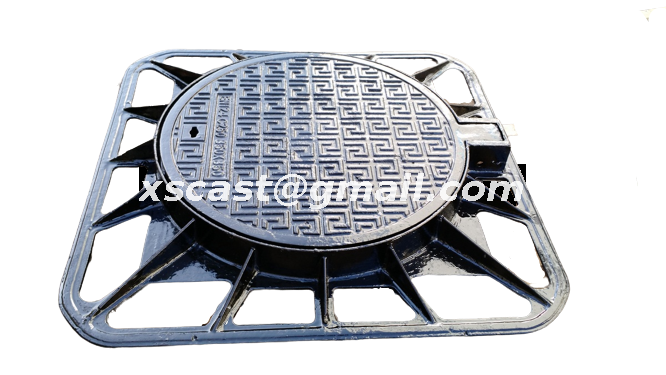
Grey iron is simpler to produce. It requires less complex metallurgical chemistry (no magnesium treatment) and has excellent vibration-damping properties. However, because it is brittle, manufacturers must cast it in much thicker sections to achieve the required strength. This results in significantly heavier covers that require larger molds and longer cooling times.
Ductile iron is the high-performance athlete of the foundry world. The addition of magnesium is a volatile process that must be carefully managed. Because ductile iron is stronger and more flexible, it can be cast in thinner sections. This requires higher precision in molding, as there is less margin for error in wall thickness. The result is a cover that is 30–50% lighter than its grey iron equivalent but capable of bearing the same load.
Composite covers flip the script entirely. They aren’t cast; they are molded. The process involves layering fibers (glass, carbon) with a resin matrix and curing them under heat and pressure.
Quality control here focuses less on metallurgy and more on curing times and resin ratios. These covers are inherently corrosion-resistant and transparent to radio signals, making them the preferred choice for utilities housing smart meters or telemetry equipment.
Quality control in 2026 is proactive rather than reactive. It’s not just about catching bad parts; it’s about preventing them.
Because recycled scrap can contain unknown contaminants, chemistry control is paramount. Automated spectrometers take samples from every “heat” (batch of molten metal). If the silicon levels are 0.1% off, the metal is not poured until it is corrected. This ensures the physical properties of the iron are consistent batch after batch.
Beyond the hydraulic load test, manufacturers also perform tensile testing. They cast small test bars alongside the manhole covers. These bars are pulled apart in a machine to measure tensile strength and elongation. For ductile iron, this proves that the magnesium treatment worked and the iron is indeed ductile, not brittle.
Fit verification checks for “seat stability.” Technicians (or automated sensors) check the gap between the cover and the frame at multiple points. In 2026, tolerances are tighter than ever to prevent noise pollution and wear. A rocking cover acts like a hammer, slowly destroying the frame and the surrounding concrete bedding—a failure manufacturers work hard to avoid through precise machining.
The foundry of 2026 is cleaner and greener. The image of the soot-choked factory floor is outdated.
The most significant environmental impact of a manhole cover is the metal itself. By using nearly 100% post-consumer scrap, foundries act as giant recycling plants. Furthermore, the sand used in molding is recycled in a closed loop, with up to 98% of it being reclaimed, reconditioned, and reused hundreds of times.
Strict air quality regulations have forced the adoption of advanced filtration systems. Baghouses and scrubbers capture dust and chemical emissions from the melting and pouring processes. Many foundries now utilize waste heat recovery systems, capturing the immense heat from furnaces to warm the factory in winter or pre-heat raw materials, drastically cutting energy consumption.
Perhaps the most effective sustainability measure is durability. Manufacturing a cover that lasts 30 years instead of 10 reduces the carbon footprint by two-thirds over the infrastructure’s life. The focus on high-grade ductile iron and precision machining is, at its heart, a sustainability strategy—reducing the need for replacement, transport, and re-installation.
Even industry professionals can hold onto outdated beliefs about casting. Let’s clear up three common myths.
This is a grey iron mindset in a ductile iron world. A 50kg ductile iron cover can easily outperform a 100kg grey iron cover. In 2026, strength comes from the metallurgy and the rib design, not raw mass.
Far from it. A cover made for a sidewalk in a mild climate is produced differently than one made for a sub-zero highway environment. The cooling rates, alloy mixes, and coating specifications vary significantly by region and application.
Modern casting is high-tech manufacturing. With real-time thermal analysis, robotic automation, and chemical precision measured in parts per million, a modern foundry has more in common with an aerospace plant than a blacksmith’s shop.
If you are a buyer or engineer, understanding the process helps you vet suppliers.
Don’t settle for vague promises. Ask for “mill test reports” or material certifications. A reputable manufacturer in 2026 should be able to trace a specific manhole cover back to the exact date and batch of metal it was poured from.
Look for manufacturers who machine and test their products in-house. Outsourcing these critical steps introduces variables that can compromise quality. An integrated facility where casting, machining, and testing happen under one roof ensures accountability.
For a private driveway, a generic cover might suffice. For a municipal sewer main or a port terminal, you need a manufacturer with a proven process for heavy-duty ductile iron. Match the sophistication of the manufacturing process to the risk level of your project.
Handan Xiangsheng Cast Co., Ltd. manufactures cast iron and ductile iron manhole covers for municipal and industrial applications, with full control over material quality, load rating, and dimensional accuracy.
Founded in 1999, the company operates a 46,000㎡ foundry with 30,000 tons annual capacity, offering EN 124–compliant solutions backed by in-house testing and machining.
Contact us to discuss specifications or project requirements!


