English ![]()

T: +86-15903202172
E: sales@xs-foundry.com
E: sales@xs-foundry.com
Linzhang Jian'an West Road 569, Handan City, Hebei Province
Views: 0 Author: Site Editor Publish Time: 2026-01-22 Origin: Site
If you are a contractor, facility manager, or civil engineer, you know that “standard” is a relative term in construction. A cover that is slightly too small for its frame is a catastrophic risk, while one that is too large simply won’t seat correctly. The difference between a secure installation and a liability often comes down to understanding manhole cover dimensions and how to measure them accurately.
Whether you are replacing a damaged lid in a residential driveway or specifying access points for a heavy-duty industrial terminal, the logic remains the same. You must prioritize the clear opening size, understand the load rating, and select the correct geometry. This guide breaks down everything you need to know about manhole cover sizes, shapes, and selection criteria to ensure your project remains safe and compliant.
Table of Cotent
Understanding Manhole Cover Dimensions: The Basics
Standard Manhole Cover Sizes Used Worldwide
Round vs Rectangular Manhole Covers: How Dimensions Differ
How Load Class Impacts Manhole Cover Dimensions
Choosing the Right Manhole Cover Size for Your Application
Material Choice and Its Effect on Manhole Cover Dimensions
Choose Your Manhole Cover
The most common mistake people make when ordering a replacement cover is measuring the old cover itself. While this seems intuitive, it almost always leads to ordering the wrong part. To understand why, we have to look at how these units are engineered and sold.
In the world of drainage and access covers, the “Clear Opening” (CO) is the king of measurements. Manufacturers list manhole cover sizes based on the size of the hole they are meant to cover, not the dimensions of the iron or steel lid.
The Clear Opening is the internal diameter or width of the manhole chamber walls. For example, if you measure the hole in the ground and it is 600mm wide, you need to order a “600mm Clear Opening” cover. The actual physical lid might measure 650mm or even 690mm to ensure it sits securely on the frame, but the product is sold as a 600mm unit. Always measure the hole, never the lid.
While length and width get all the attention, thickness is equally vital. The depth of the cover often dictates how much bedding mortar is required and how the unit sits flush with the surrounding pavement.
Heavier duty covers, such as those rated for highway use, generally have a greater depth to accommodate the structural ribbing required to support 40 tons of traffic. If you are replacing a cover in an existing frame, the thickness must match, or you create a tripping hazard. If you are installing a new frame, you must ensure the excavation depth allows for the frame height plus the necessary bedding material.
A manhole cover is part of a system that includes the frame (or rim). The external dimensions of the frame are critical during installation. You need to ensure that the flange of the frame has enough surface area to rest securely on the concrete bedding. If the frame is too narrow for the chamber walls, the load won’t be distributed correctly, eventually causing the surrounding concrete to crack and crumble.
While custom fabrication is possible, the construction industry relies on specific standardized sizes to keep costs down and maintenance easy. However, depending on where your project is located, you might encounter different units of measurement.
In the UK, Europe, and many parts of Asia, sizes are strictly metric. You will see listings for 300mm, 450mm, or 600mm covers. In North America, imperial measurements dominate.
This often leads to confusion when sourcing parts globally. A 24 inch manhole cover is essentially the industry equivalent of a 600mm metric cover (24 inches is approximately 609mm). While they are functionally similar, they are rarely interchangeable. A 600mm metric lid will likely not fit into a 24-inch imperial frame due to slight variances in manufacturing tolerances and seating designs.
Manufacturers generally stick to a few key sizes that align with standard chamber sizes:
300mm x 300mm (approx 12 inch): Typically used for domestic inspection chambers, often found in driveways or gardens to access shallow drainage.
450mm x 450mm (approx 18 inch): A step up in size, common for domestic driveways and larger drainage junctions.
600mm x 600mm (approx 24 inch): The standard for personnel access. If a person needs to enter the chamber, this is generally the minimum required size.
1200mm x 600mm: Often used for larger utility vaults where equipment needs to be lowered in, or two people need to access the area simultaneously.
Despite these standards, you will frequently encounter odd sizes, particularly in older cities. Legacy infrastructure from the early 20th century often utilized bespoke sizes or imperial measurements that don’t align with modern metric bricks. In these cases, you usually cannot buy an off-the-shelf replacement lid. The solution is usually to excavate the old frame and install a completely new cover and frame set that meets modern dimensional standards.
The shape of the cover dictates how you measure it and where it should be installed. The choice between a round manhole cover and a rectangular one is rarely just about aesthetics—it is a matter of physics and structural integrity.
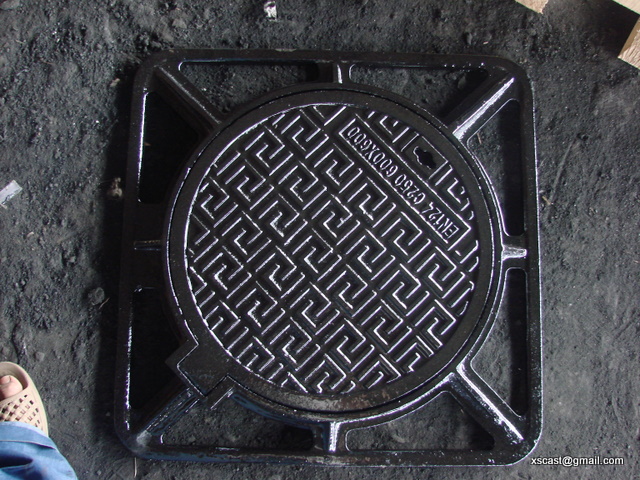
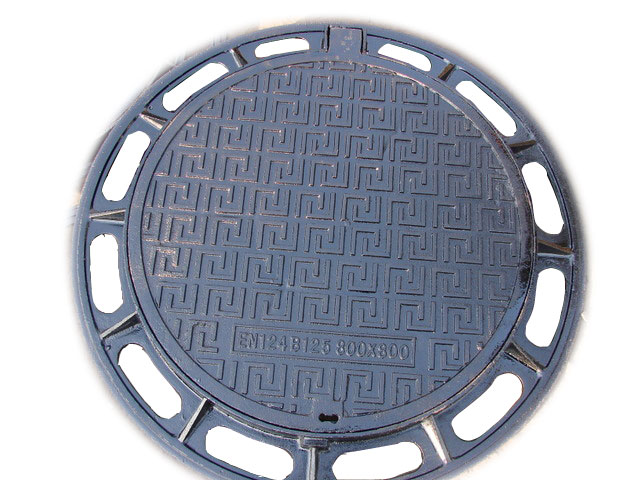
You will notice that almost all heavy-duty sewer access points on public roads use round manhole covers. There is a geometric reason for this: a round cover cannot fall through its own circular opening. No matter how you twist or turn a circle, it is the same width all the way around.
This safety feature is critical for roadway applications where heavy traffic vibration could potentially shift a cover. When measuring a round cover, you only need one dimension: the diameter of the clear opening.
Rectangular manhole covers (and square ones) are susceptible to falling into the hole if they are turned diagonally, as the diagonal length of the hole is wider than the side of the cover.
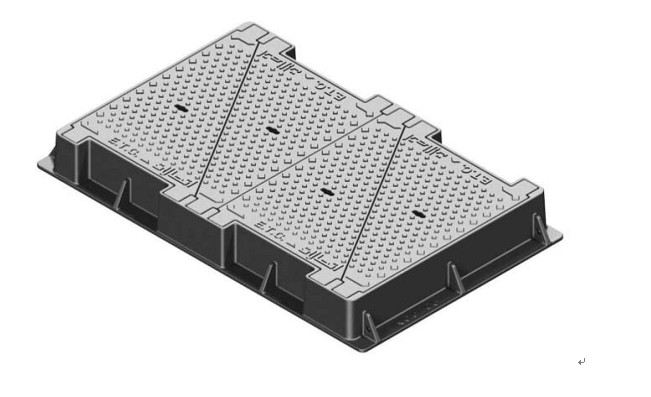
Despite this, rectangular covers are essential for many applications. They are commonly used for telecommunications, electrical signalling, and shallow drainage where the underground chamber matches the shape of floor tiles or paving blocks. When measuring these, you must take both the length and width of the clear opening.
The shape also impacts how dimensions relate to strength. Round covers naturally distribute the stress of a wheel load evenly across the rim. Rectangular covers often have “weak points” at the center or corners, requiring additional reinforcement ribs. This is why a rectangular cover of the same clear opening size as a round one might need to be thicker or made of heavier material to achieve the same load rating.
You cannot talk about manhole cover dimensions without discussing weight load. The physical size of the cover (specifically its thickness and material density) is directly tied to how much weight it can support.
The European Standard BS EN 124 is the global benchmark for load classes. It dictates that covers must be tested to withstand specific forces.
A15 (1.5 tonnes): For pedestrians only. These are thin and light.
B125 (12.5 tonnes): Driveways. Thicker, often with light ribbing.
C250 (25 tonnes): Lightly trafficked roads/parking.
D400 (40 tonnes): Main roads. These are heavy, thick units with substantial depth.
E600 & F900 (60-90 tonnes): Docks and airports. These are massive, deep-seated covers.
To pass a D400 test, a cover must not just hold the weight; it must not deflect (bend) beyond a certain tolerance. To achieve this rigidity, manufacturers must add depth to the design. A 600mm D400 cover might be 100mm deep, whereas a 600mm A15 cover might only be 30mm deep.
You might see two covers that are both 600mm square, yet one is rated A15 and the other D400. The difference lies in the material and the underside engineering. The D400 version will be made of ductile iron (or heavy steel) and feature a complex network of reinforcement ribs underneath. The A15 version might be pressed steel or thin cast iron with a flat bottom. This reinforces why visual estimation of size is not enough—you must check the specification.
On a sidewalk, the vertical dimension (depth) is less critical because the slab is thinner. In a roadway, the frame needs to be deep enough to be anchored into the sub-base of the road, not just the asphalt surface. This prevents the frame from sinking under the constant pounding of trucks.
Static weight (a parked car) is different from dynamic weight (a braking truck). Dynamic loads create shockwaves. Covers designed for roadways (D400+) have dimensional tolerances that ensure a tight fit. If the fit is too loose, the dynamic load causes the cover to “chatter,” which grinds down the metal frame over time, changing the internal dimensions and ruining the installation.
The most frequent failure we see is installing a B125 (driveway) cover in a commercial delivery zone. Even if the cover fits the hole size perfectly, it lacks the vertical thickness and structural density to handle a delivery truck. The result is a buckled or cracked cover that creates an immediate hazard.
Selecting the right product doesn’t have to be a guessing game. Follow this four-step logic to ensure a perfect fit.
Ignore the old lid. Remove it if possible. Take a tape measure to the hole in the ground. Measure the distance from internal wall to internal wall. If it is rectangular, measure both width and length. If it is circular, measure the diameter. This is your “Clear Opening” size.
Look at where the cover is located.
Is it in a garden? A15 is sufficient.
Is it in a driveway? B125 is the minimum.
Is it in a public car park or road? You need D400.Do not undercut the load class to save money on a thinner cover. It will cost more in the long run when it breaks.
Who needs to get in there? If it is just for rod access to clear a drain, a 300mm or 450mm cover is fine. If a person needs to climb in, you must ensure your chosen frame provides a minimum of 600mm clear opening. Installing a smaller frame over a large hole restricts access and may violate safety codes for confined space entry.
Before purchasing, check if your local municipality has specific requirements. Some cities require specific frame depths or badging (e.g., “SW” for Stormwater or “FW” for Foul Water) on the surface.
The material you choose changes the strength-to-weight ratio, which influences the dimensions of the final product.
Grey cast iron is brittle. To make it strong enough for roads, it has to be incredibly thick and heavy. Ductile iron is a modern alloy that is flexible and strong. A ductile iron cover can be much thinner and lighter than a cast iron one while holding the same weight. This makes ductile iron the preferred choice for most modern sizes as it is easier for one person to lift.
Composite (fiberglass/plastic) covers are gaining popularity because they don’t corrode and have no scrap value (preventing theft). Because composite materials aren’t as rigid as iron, high-load composite covers are often thicker than their iron counterparts to achieve the stiffness required.
Galvanized steel covers are often used for “recessed” or “block pave” applications. These are designed as a tray to hold bricks or pavers. Their dimensions are unique because you have to account for the depth of the tray plus the pavers to ensure the finished level matches the ground.
Manhole cover dimensions are never a “one-size-fits-all” scenario. The interplay between the clear opening, frame depth, load rating, and material choice defines the safety and longevity of your infrastructure. A mismatched cover is not just an inconvenience; it is a structural weakness waiting to be exposed by the next heavy vehicle that passes over it.
By strictly adhering to the Clear Opening measurement method and respecting the relationship between load class and cover thickness, you can select replacements with confidence.
Handan Xiangsheng Cast Co., Ltd. manufactures cast iron and ductile iron manhole covers for municipal and industrial applications, with full control over material quality, load rating, and dimensional accuracy.
Founded in 1999, the company operates a 46,000㎡ foundry with 30,000 tons annual capacity, offering EN 124–compliant solutions backed by in-house testing and machining.
Contact us to discuss specifications or project requirements!