
English ![]()

T: +86-15903202172
E: sales@xs-foundry.com
E: sales@xs-foundry.com
Linzhang Jian'an West Road 569, Handan City, Hebei Province
Views: 0 Author: Site Editor Publish Time: 2026-03-12 Origin: Site
Infrastructure planning often requires decisions that seem simple at first but carry long-term consequences. A common example appears when engineers must choose between different shapes of access covers installed in roads, sidewalks, or utility chambers. Both circular and square designs exist in modern infrastructure systems, and each serves a practical role depending on the environment. When discussing manhole covers, engineers often compare round and square formats to determine which design offers the best combination of safety, durability, and accessibility. The answer is rarely universal. Instead, the correct choice depends on traffic conditions, underground chamber structure, and the specific maintenance needs of the project. Understanding the real differences between these two shapes helps project planners select the most suitable solution for long-term performance.
At first glance, the difference between these two shapes appears purely visual. In reality, the shape influences how the cover interacts with the frame, how it responds to mechanical stress, and how easily workers can access the chamber beneath it.
A cover must sit securely within a supporting frame embedded in pavement or concrete. The geometry of the cover determines how the load transfers to that frame. Circular covers distribute force evenly around the perimeter, while square covers transfer force primarily along the edges and corners. This difference affects structural performance under heavy loads.
Handling a cover during installation or maintenance is another important consideration. A circular plate can be rotated freely and positioned easily on its frame, while a square cover must be aligned correctly with the edges of the opening. The design also affects how the cover seals against the frame and how it behaves when exposed to repeated traffic vibration.
Neither design is automatically superior. The choice depends on practical project requirements. Roads with heavy vehicle traffic often benefit from round covers, while utility chambers or landscaped areas may function well with square access points.
Circular covers dominate many urban road systems because they offer several engineering advantages that become important in high-traffic environments.
One of the most widely recognized advantages of round covers is that they cannot fall through their own opening. Because the diameter of the cover remains constant in every orientation, the plate always rests securely on the frame. This safety feature is particularly valuable during maintenance work when covers are frequently removed and replaced.
Round covers are easier for maintenance teams to move. Workers can tilt the edge and roll the cover along the pavement instead of lifting it entirely off the ground. Considering that cast iron covers can weigh dozens of kilograms, this design significantly reduces the physical effort required for routine inspections.
Circular geometry distributes pressure evenly around the frame. When vehicles pass over the cover, the load spreads smoothly across the structure rather than concentrating at corners. This balanced load distribution improves durability and helps prevent cracking over long periods of use.
Although round covers dominate road infrastructure, square designs still offer benefits in certain applications.
Square covers often provide a slightly larger access area compared with circular openings of similar width. This can make it easier for technicians to enter the chamber or move equipment in and out during installation or repair work.
Many underground utility chambers are constructed with rectangular or square walls. In these cases, a square access opening can align naturally with the structure. This alignment simplifies construction and allows the cover to fit neatly within the surrounding pavement.
Sidewalk installations, park infrastructure, and landscaped areas sometimes use square covers because they match paving patterns more easily. When visual alignment with tiles or stone patterns is important, square designs may integrate more smoothly into the overall layout.
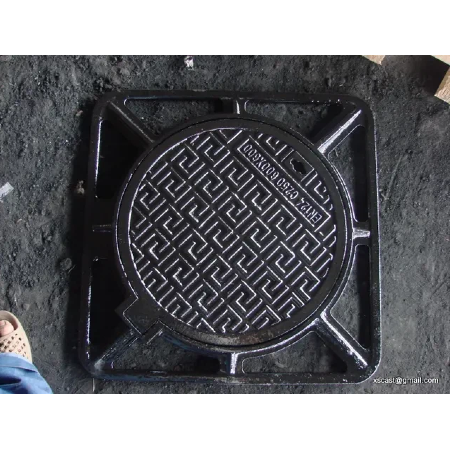
Load performance is one of the most important considerations when selecting access covers for roads and public infrastructure.
Round covers distribute mechanical stress evenly around the entire perimeter of the frame. Because there are no corners, pressure from passing vehicles spreads uniformly across the structure. This reduces the likelihood of structural fatigue or cracking over time.
Square covers contain corners that may become stress concentration points under heavy loads. When vehicles pass over the cover repeatedly, these corners may experience higher localized pressure. Proper engineering design and material selection can mitigate this issue, but it remains a factor engineers must consider.
Shape alone does not determine durability. Material quality, casting accuracy, and frame design all influence how well the cover performs under traffic loads. High-strength ductile iron is widely used because it provides excellent resistance to repeated mechanical stress.
Handan Xiangsheng Cast Co., Ltd. produces cast infrastructure products using controlled foundry processes and advanced machining equipment. These manufacturing capabilities help ensure that both round and square designs maintain reliable structural performance.
Installation efficiency and maintenance convenience also influence the choice between different shapes.
Because every rotation of a circle looks the same, workers do not need to worry about orientation when replacing the cover. The plate can simply be placed back on the frame and will fit correctly regardless of how it is positioned.
Square covers may align more naturally with paving patterns such as concrete slabs, tiles, or stone blocks. In landscaped areas or pedestrian plazas, this alignment can simplify installation and create a cleaner visual appearance.
Engineers often prioritize structural performance and safety, while maintenance crews focus on handling convenience. The final choice of shape may depend on which factor is more important for the project.
Beyond engineering considerations, appearance can also influence infrastructure design.
On asphalt roads, circular covers often appear less visually intrusive. The curved shape contrasts less sharply with the surrounding pavement and tends to blend into the road surface.
In plazas or sidewalks with geometric paving patterns, square covers can align neatly with the surrounding tiles. This alignment creates a more consistent visual layout across the surface.
Commercial districts, parks, and public plazas often prioritize aesthetic integration. In such projects, the choice between round and square designs may depend partly on visual harmony with surrounding materials.
Selecting the correct design requires evaluating several practical factors related to the installation environment.
If the underground chamber is circular or designed for vertical shaft access, a round cover usually provides the most efficient solution. If the chamber has a rectangular structure or requires a wider opening, a square cover may be more appropriate.
Load classification remains one of the most important technical considerations. Engineers must ensure that the chosen cover meets the required strength standards for the expected traffic conditions.
Environmental conditions such as heavy rainfall, temperature fluctuations, or frequent vehicle vibration can influence long-term performance. Proper frame design, gasket systems, and material quality all contribute to reliable operation.
Handan Xiangsheng Cast Co., Ltd. has specialized in manufacturing cast infrastructure components since 1999. The company operates a modern production facility covering more than 46,000 square meters and maintains an annual production capacity of 30,000 tons. Dedicated casting workshops, machining facilities, and quality testing systems enable the production of durable covers used in municipal roads, drainage networks, and industrial installations.
Comparison Point | Round Cover | Square Cover | Best Fit Scenario |
Structural strength | Even stress distribution | Stress may concentrate at corners | Heavy traffic roads |
Safety | Cannot fall through opening | Requires careful frame design | Urban road access |
Installation | Easy to rotate and reposition | Must align with frame edges | Sidewalk or paving layouts |
Access space | Moderate opening size | Often larger usable opening | Utility chambers |
Visual integration | Blends with asphalt roads | Aligns with geometric paving | Landscaped or commercial areas |
Both shapes play an important role in modern infrastructure, and each design has advantages depending on the environment. Round covers often provide stronger load distribution and easier handling for road systems, while square covers may offer larger access openings and better alignment with structural layouts. Understanding these differences allows engineers and planners to choose the most suitable manhole covers for their projects. Handan Xiangsheng Cast Co., Ltd. supplies durable cast products designed for municipal roads, drainage systems, and industrial infrastructure. If your project requires reliable underground access solutions or customized utility access covers, our technical team is ready to assist.
Contact Us
For specifications, technical details, or customized casting solutions, please contact Handan Xiangsheng Cast Co., Ltd. Our engineers are available to support municipal construction, road engineering, and infrastructure development projects around the world.
Round covers often distribute load more evenly because they have no corners. This design helps them perform well under heavy traffic conditions.
Square covers are commonly used in sidewalks, landscaped areas, or utility chambers where a larger access opening is beneficial.
Round designs prevent the cover from falling into the opening and provide better load distribution under vehicles.
Yes. Many foundries, including Handan Xiangsheng Cast Co., Ltd., manufacture both shapes and can also provide customized sizes for specific infrastructure requirements.


