
English ![]()

T: +86-15903202172
E: sales@xs-foundry.com
E: sales@xs-foundry.com
Linzhang Jian'an West Road 569, Handan City, Hebei Province
Views: 0 Author: Site Editor Publish Time: 2026-03-06 Origin: Site
City streets are full of small engineering details that most people pass by every day without noticing. One of the most familiar examples is the round metal plate set into the pavement that allows workers to access underground utility systems. When people begin to ask why this design appears almost everywhere, the answer leads to an interesting combination of engineering logic, safety considerations, and maintenance practicality. The shape of manhole covers is not a random tradition or a simple design preference. Instead, it reflects decades of experience in urban infrastructure development. The circular design helps improve safety, durability, and efficiency in real-world conditions, which is why round covers have become the most widely used format in roads and municipal systems.
Safety is the most frequently cited explanation for the round design, and it remains the most convincing reason.
A circular cover cannot drop into the shaft beneath it because the diameter of the cover is always wider than the opening it sits on. No matter how the cover is rotated, the geometry prevents it from slipping through. This simple physical principle provides an important safety advantage. Workers opening a cover do not need to worry about the plate accidentally falling into the chamber and causing damage or injury.
Square covers behave differently. When positioned in one direction they may rest securely on the frame, but if rotated diagonally they could theoretically slip through an opening designed for the square shape. Engineers have to compensate for this by designing larger support edges or additional reinforcement. The circular design avoids this issue entirely.
Maintenance crews frequently open and close access points during inspection or repair work. A design that eliminates the risk of dropping a heavy cover into the chamber significantly reduces hazards for workers. In busy city streets where maintenance often occurs quickly, this safety factor becomes even more important.
Another key advantage of the round design relates to how weight and pressure are distributed across the cover.
Square or rectangular shapes contain corners that can become structural stress points when exposed to heavy loads. Vehicles passing over the cover create concentrated pressure in these areas. Over time, repeated stress may lead to cracking or deformation.
Circular shapes do not have corners. Instead, the load is distributed evenly around the perimeter. This allows the cover and frame to absorb pressure more efficiently and maintain structural integrity for longer periods.
Road infrastructure must handle constant vehicle movement. Trucks, buses, and heavy construction equipment generate repeated loads that can reach several tons. A round cover spreads this pressure uniformly across the supporting frame, reducing the likelihood of structural failure.
Because of this even load distribution, round designs typically experience less mechanical stress. As a result, they tend to last longer and require fewer replacements. This durability makes them particularly suitable for roads and highways where reliability is essential.
Beyond safety and structural performance, practical maintenance considerations also influence the design.
Manhole covers are often made from cast iron or ductile iron and can weigh more than fifty kilograms. Moving such a heavy component repeatedly would be difficult if workers had to lift it entirely off the ground.
A round shape allows the cover to be rolled along the pavement. Workers can tilt the edge and rotate the cover instead of carrying it. This significantly reduces the physical effort required during installation or maintenance.
Square covers must be positioned carefully so that the edges align with the frame. If the orientation is incorrect, the cover may not sit properly in place.
Round covers eliminate this issue. Because every rotation looks the same, workers can simply place the cover back on the frame without worrying about alignment.
Maintenance work often takes place in busy traffic areas where speed is important. A design that simplifies handling allows crews to complete tasks more efficiently. Over time, this small advantage translates into significant labor savings for municipal authorities.
The logic behind round covers extends beyond the surface. Underground structures also benefit from circular designs.
Many underground chambers are constructed with circular shafts. The circular structure distributes pressure from surrounding soil evenly along the wall. This design helps maintain stability over long periods.
Underground infrastructure must resist the natural pressure of soil and groundwater. Circular shafts provide stronger resistance to these forces compared with shapes that include corners.
When the shaft and the cover share the same geometry, installation becomes simpler and structural forces are distributed more efficiently. The round cover sits securely on a matching circular frame, creating a balanced support structure.
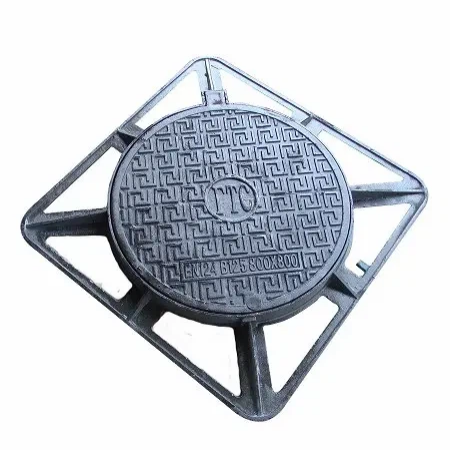
Although the circular design is extremely common, it is not the only possible solution.
Certain underground structures require wider openings or special layouts. Utility chambers containing large equipment or cable networks may benefit from square or rectangular access points.
Telecommunication systems and electrical vaults often contain equipment that must be installed or removed through the opening. A square design may provide more usable space for these tasks.
Engineers select the shape that best fits the technical requirements of the installation. While round designs dominate road networks, other shapes remain valuable for specialized applications.
While shape plays an important role, other engineering factors remain equally important for reliable infrastructure.
Even a round cover must be designed to withstand the correct traffic load. Covers used in pedestrian areas require far less strength than those installed on highways.
Material selection significantly affects durability. Ductile iron has become the preferred choice for many modern infrastructure projects because it combines strength with resistance to cracking.
Handan Xiangsheng Cast Co., Ltd. manufactures high-strength ductile iron products using controlled casting techniques and strict quality inspection. These processes ensure that each cover maintains reliable structural performance.
The frame that supports the cover must be precisely machined to ensure a tight and stable fit. Poor alignment between the cover and frame can cause vibration, noise, or premature wear.
A well-designed system integrates the cover and frame so that they work together under load.
The widespread use of round covers offers valuable insight into infrastructure engineering.
Design decisions in civil engineering are rarely based on appearance alone. The popularity of round covers reflects decades of experience in solving real maintenance and safety challenges.
Infrastructure components must be easy to install, inspect, and replace. The circular design simplifies these tasks while maintaining strong structural performance.
Even the best design cannot succeed without proper manufacturing quality. Producing durable covers requires precise casting methods, consistent material composition, and strict testing procedures.
Handan Xiangsheng Cast Co., Ltd. has focused on cast infrastructure products since 1999. The company operates a large production facility covering 46,000 square meters with an annual output of 30,000 tons. Modern casting workshops, machining equipment, and physical and chemical testing systems ensure that each product meets demanding engineering requirements. These capabilities allow the company to supply dependable covers used in municipal roads, drainage networks, and industrial infrastructure.
Design Benefit | Practical Meaning | Impact on Safety | Impact on Maintenance |
Circular geometry | No corners to weaken the structure | Reduces risk of cracking under heavy loads | Longer service life |
Cannot fall through opening | Cover always wider than shaft | Prevents accidents during maintenance | Safer handling for workers |
Easy handling | Cover can be rolled instead of carried | Reduces lifting hazards | Faster installation |
Simple alignment | No orientation required | Ensures proper seating | Saves maintenance time |
Balanced load distribution | Pressure spread evenly across frame | Greater stability under traffic | Lower replacement frequency |
Round manhole covers became the standard choice in urban infrastructure because the design offers multiple practical advantages. The circular shape prevents the cover from falling into the opening, distributes traffic loads evenly, and simplifies handling during maintenance work. These benefits explain why engineers around the world continue to rely on this design for road and utility systems. Handan Xiangsheng Cast Co., Ltd. applies the same engineering logic in the production of high-strength cast products used in municipal and industrial infrastructure. For projects that require durable access systems and reliable underground protection, our team provides dependable access covers designed for long-term performance.
Contact Us
If you are planning municipal construction, road engineering, or infrastructure upgrades, our technical team is ready to assist. Handan Xiangsheng Cast Co., Ltd. supplies durable cast products for a wide range of applications. Contact us today to learn more about available specifications and customized casting solutions.
Round designs prevent the cover from falling into the opening and distribute traffic pressure evenly, making them safer and more durable.
Most road systems use round covers because they handle heavy loads well, but square or rectangular designs may appear in utility chambers or cable vaults.
Ductile iron is widely used because it provides excellent strength, flexibility, and resistance to repeated vehicle pressure.
Maintenance typically involves routine inspection and cleaning. A well-manufactured ductile iron cover can remain reliable for many years with proper installation and periodic checks.


